Enough Violence

I don’t feel able. Not at the moment.

I don’t feel able to write. To eat. To do anything. To move from this couch. Even to smile.

It took the wind out of my sails to look at the number of Twitter “Followers” I have.

95

As if my value as a living being can be defined by my number of “Followers,” the tidiness of my home, size of my bank account, or the shape of my ass. And it strikes me that if I am feeling defined by those numbers and categories, then I must be defining you by those things, too.

Comparison.

J.Krishnamurti asked, “Isn’t comparison a form of violence?”

It kills you. It just kills you. Or me, anyway. It kills me. Crushes me. Crushes my ideas of being or doing something great. Or even something good. Or even just doing.

Yes, I say. Yes. Most definitely. Comparison is violence. Against the self and against others. It cuts. Burns. Obliterates. It decimates, with it’s judgment.

Whose is better? Who has more? Who’s been doing it longer? Who was paid more?

I feel lost in blankness. And it follows me.

Not good enough. Not fast enough. Not young enough. Not beautiful enough. Not tidy enough. Not clever enough.

Just plain not enough.

Not enough.

I have typed it eight times now. Enough. And now nine. It looks strange. “Enough.” The word has mutated in my vision to become a meaningless sequence of characters. Six shapes arranged just so. Making a word I have used many times in my thoughts, and aloud, to describe myself. And to describe others.

E — N — O — U — G — H

Could it be that the lack of meaning that happens when we say, write, or type a word over and over and over reflects the lack of meaning a word can actually and truly convey about someone? About me? Or you?

Really.

How can someone be not “enough”?
Enough for whom? Enough for what? And who determines enoughness?

Just as the word “enough,” repeated so many times becomes a muddy alphabetic mixup, so the concept of “enough,” becomes a meaningless mashup of comparison. Of violence. Against myself. And against others.

If I am here, and I am here, typing this, thinking this, then what about me is not enough?

And if you are here, breathing, seeing, reading, then what about you could possibly be not enough.

I say, I am enough. I say you are enough. We are enough.

Enough said.
Until Recently I Thought

Until recently, I thought I was the only person who ever did a, “Mom’s Got A New HairDoo Freakout.”

Thing is, I didn’t recognize her.

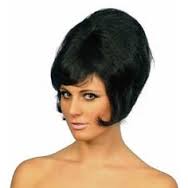
Beehive - 1

Not that I wouldn’t have recognized my own mom.

I mean, it wasn’t her, it’s not just that I didn’t recognize her.

It’s that with the change in her hair, all pushed up onto the top of her head, she had slipped into a part of her self that was simply unfamiliar to me; a part I’d never met. I remember she was wearing a light-colored, patterned, sleeveless sundress hemmed just below the knee. It must have been early summer as she looked light and breezy. It didn’t matter how summery and sweet she may have looked, though. This wasn’t my mom and she wasn’t fooling anyone with her costume and fashionable hair.

Had I been introduced to her independently of her being my mother, I might have thought her stunning in her new hairstyle; it was in the vicinity of 1965 and beehives were “in.” But as she was my mother, and she was in a non-mother get-up, I deemed her “stranger,” and, thus, ugly.

Change has always been tough for me.

If, as Buddhist nun Pema Chodron’s has said, our root fears are pain, abandonment, and death, where does the fear of change fit in? Or does it fit into all three? The anticipated, possible pain of the unfamiliar or new, the abandonment of what was counted on, and the death of what was known. All three root fears are found in the fear of change.

It’s that the new hair treatment endued her with another of her potential personalities, one of her other Selves.

We all have them, potential personalities, other Selves.

Some of our Selves we may never get, or take, the chance to try on and walk around in.

Some, we may live most of our life inside of.

Some, we may have the good fortune to let go of after experimenting with them.

And some, we may live through miserably, unable or unwilling to peel off and discard.

When I saw her in her beehive hair-doo Self, I burst into tears. Afraid and stunned, frozen; I didn’t understand. I was five, or two, or seven, and I didn’t understand.

I had gone to school that morning only to come home to this very different person. My mother had gone; had left me. My familiar mother had escaped into, or been inhabited by this “other,” mother, a person I no longer knew.

I sobbed. And the shell of my mother, with her bare, brown arms and teased and piled hair, bent down to comfort me, and it was fake. My skin burned with her touch, my ears rejected the comforting cooing noises she made.

And now it was she who did not understand, did not realize, just as she had slid into one of her other Selves, so I had vanished as well.